

What Makes Buyers Pay More for One House Than Another?
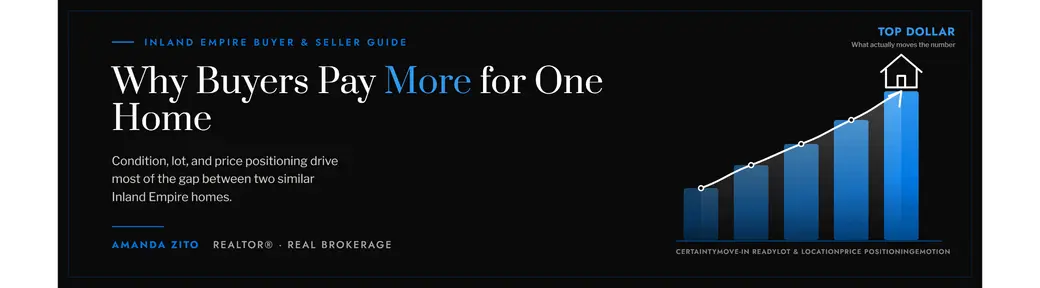
What makes buyers pay more for one house than another? Buyers pay more for homes that feel move-in ready, priced in line with recent comparable sales, and located where they want to be. In the Inland Empire, condition, layout, and price positioning drive most of the gap between two similar homes.
Two Nearly Identical Homes, Two Very Different Outcomes
Picture two houses on the same street in Eastvale. Same builder, same floor plan, same square footage, same year built. One sells in eleven days at full price. The other sits for two months, takes two price reductions, and closes under asking.
The homes were not actually identical — and buyers noticed the differences long before they wrote an offer.
This is one of the most common questions I get from both sides of the transaction. Sellers want to know why the neighbor got more. Buyers want to know whether the house they love is worth what the seller is asking. The answer is the same for both of you, and it has less to do with granite countertops than most people assume.
Here's what actually moves the number in Riverside County and San Bernardino County.
Buyers Pay a Premium for Certainty
Every offer a buyer writes is a bet. They're wagering a down payment, their moving timeline, and often their peace of mind on a property they've walked through for maybe forty-five minutes.
The more confident a buyer feels, the more they'll pay. The more question marks they see, the more they discount — and they discount conservatively, because they're guessing.
That's why a clean, well-documented home outperforms a home with unknowns. A buyer looking at a roof they can't age, a permit history they can't verify, or an HVAC system nobody can speak to will subtract more than the actual repair would cost. They're pricing in risk, not just repair.
Sellers who front-load information — receipts, permits, service records, a pre-listing inspection — remove the guesswork. Buyers reward that.
Condition and Move-In Readiness
Most buyers in the Inland Empire are not looking for a project. Between a competitive rate environment and the cost of getting into a home, very few have cash left over on closing day for a full renovation.
So the home that requires nothing on day one commands a premium over the home that requires a weekend of work — even when that weekend of work is genuinely minor.
What buyers respond to most:
- Paint and flooring. These read as "everything" to a buyer walking through, even though they're among the cheaper fixes.
- Kitchens and primary bathrooms. Dated is survivable. Non-functional is not.
- Smells, light, and clutter. Impossible to quantify on an appraisal, extremely easy to feel in person.
- Curb appeal. In Corona, Ontario, and Rancho Cucamonga, buyers frequently drive by before they ever tour. A tired exterior loses showings that never get scheduled.
The gap here isn't rational, and that's the point. Two homes with the same bones can be perceived very differently, and perception is what generates offers.
The Things Buyers Can't Change
There's a useful line to draw: buyers will pay the most for the things they cannot fix.
Countertops can be replaced. A busy road cannot. A pool can be added. A north-facing backyard with no shade in a Murrieta summer cannot be reoriented.
Factors in this category carry outsized weight:
- Lot — size, usable yard, slope, privacy, and whether the backyard backs to open space or to another home's second story
- Location within the neighborhood — interior street versus arterial, cul-de-sac versus through traffic
- Floor plan — a downstairs bedroom or full bath, a true primary suite, an open sightline from kitchen to family room
- Views — hillside and mountain views in Redlands and Rancho Cucamonga are permanent value
- Parking and storage — three-car garages and RV access are a real differentiator across the Inland Empire
When two homes are otherwise comparable, this is usually where the price gap lives.
Price Positioning Against the Comps
Here's the piece sellers underestimate: the home itself isn't the only thing being evaluated. Buyers are comparing it to everything else available at that moment.
A home priced at the top of its comparable range has to be the best home in that range. If it isn't, buyers simply move to the listing that is, and the overpriced home becomes the one that makes the others look like good value.
Days on market compounds this. A listing that sits starts generating its own narrative — buyers assume something is wrong, and offers arrive lower than they would have in week one. You can review recent sale trends for the region through sources like Redfin's Riverside market data and Realtor.com's local market reports, but comparable selection at the neighborhood level is where the real accuracy lives.
Terms, Timing, and Financing
Two buyers can offer the same price and deliver very different value to a seller. The reverse is also true: two sellers can list at the same price and one is far easier to buy.
Things that shift what a buyer is willing to pay:
- Flexibility on close and possession. A seller who can accommodate a buyer's lease end or a rent-back is worth real money.
- What's staying. Solar status matters enormously in the Inland Empire — an owned system is an asset, a leased system is a negotiation.
- HOA and Mello-Roos. In newer Eastvale and Menifee communities, monthly costs directly reduce a buyer's purchasing power. Two homes at the same price are not the same payment.
- Rate environment. As borrowing costs shift, so does what a given buyer can afford to bid. Freddie Mac's weekly mortgage rate survey is the standard reference.
Emotion Sets the Ceiling
Logic gets a buyer to a reasonable number. Emotion is what pushes them past it.
The buyer who can picture holidays in that dining room, who walks into the backyard and exhales, who tells their agent "this is the one" on the way to the car — that's the buyer who stretches. NAR's research on buyer behavior consistently shows how much of the decision is driven by feel rather than spreadsheet.
For sellers, this is why presentation is not vanity — it's strategy. For buyers, it's worth knowing that the feeling is real but the price should still be defensible. Fall in love with the house; stay disciplined about the comps.
Frequently Asked Questions
Do upgrades always increase what buyers will pay in the Inland Empire? No. Upgrades that bring a home to market standard — flooring, paint, functional kitchens and baths — typically pay off. Highly personalized or over-improved features often don't return their cost, especially if they push the home above the neighborhood's price ceiling.
Why did my neighbor's house sell for more than mine when they're the same model? Usually some combination of condition, lot, timing, and how the home was priced and marketed on day one. Same floor plan does not mean same home — and market conditions can shift meaningfully between two sales just a few months apart.
How much does days on market affect final sale price? The longer a home sits, the more negotiating leverage shifts to buyers. Listings that go stale tend to attract lower offers than they would have during their first two weeks, which is why accurate initial pricing matters more than leaving room to come down.
Let's Talk About Your Situation
Whether you're trying to figure out what your home should list for, or whether the house you're touring is worth what they're asking, the answer comes from the specific comps in your specific neighborhood — not from a general rule.
Call or text me and we'll walk through it together.
Amanda Zito REALTOR® | Inland Empire & High Desert, California Real Brokerage CA DRE #01740063
Categories
Recent Posts











“Your goals come first. My job is to help you make the right move.”