

Which Home Improvements Actually Add Value?
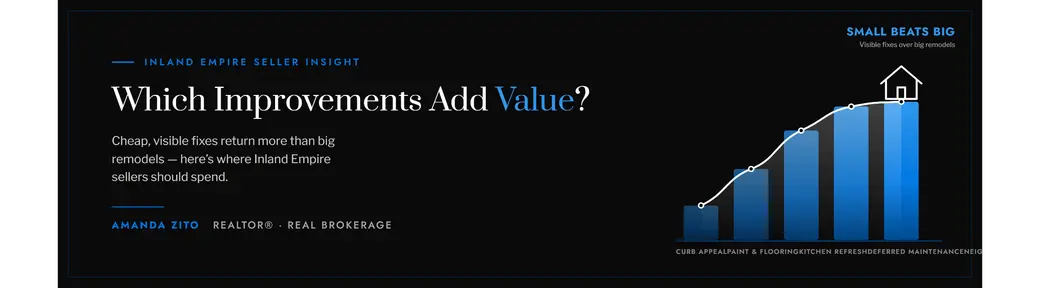
Which home improvements actually add value to a home in the Inland Empire? Smaller, visible, condition-based projects — curb appeal, paint, flooring, and light kitchen and bath updates — return the most at resale. Large custom projects like pools and room additions rarely return what they cost.
Almost every seller I meet in Riverside and San Bernardino County has a version of the same question: should we fix it, or sell it as-is? And usually there's a contractor quote sitting on the kitchen counter for something big — a full kitchen gut, a pool, an addition off the back.
Here's the part that surprises people. The projects that add the most value at resale are almost never the expensive ones. They're the cheap, visible ones. Buyers form an opinion of your home in the first thirty seconds — driveway, front door, entry, light, smell — and everything after that is them either confirming or reversing that first impression.
So the real question isn't "what should I renovate?" It's "what is a buyer in my price range in my city going to notice, and what will they pay for?" Those are two different lists. Below is how I sort them.
The Improvements That Usually Pay Off
Curb appeal and the exterior
This is the highest-leverage money you can spend before listing, and it's not close. Exterior projects consistently outperform interior remodels in the annual Cost vs. Value Report, and the reason is simple: they're the first thing a buyer sees and the cheapest thing to fix.
In practical terms for an Inland Empire home, that means:
- A clean or replaced garage door — on most tract homes here, the garage is a third of the front elevation
- Fresh exterior paint, or at minimum a repainted front door and trim
- Working, matched exterior lighting
- Drought-tolerant landscaping that's alive and edged — not elaborate, just intentional
- Pressure-washed driveway, walkway, and stucco
Half of that list is a weekend and a few hundred dollars. It moves the needle more than a $60,000 kitchen.
Paint, flooring, and light
Neutral interior paint and updated flooring are the two most reliable interior spends before a sale. They don't add value the way an appraiser might describe it — they remove objections. A buyer walking a home in Corona or Eastvale with worn carpet is mentally subtracting $15,000 and a month of hassle, which is far more than the flooring actually costs you to replace.
Same with lighting. Swapping dated fixtures and adding brightness is cheap and photographs well, and in this market the photos are the showing.
Kitchen and bath — refresh, don't gut
This is where sellers most often overspend. A minor, mid-range kitchen update — refaced or repainted cabinets, new hardware, counters, an updated sink and faucet — returns dramatically more of its cost than a full upscale remodel does. The same pattern holds in bathrooms: new vanity, mirror, fixtures, lighting, and fresh grout beats a tear-out-to-the-studs project on pure return.
The logic is arithmetic. A gut remodel can cost six figures and still only add a fraction of that to the sale price. A refresh costs a small fraction and closes most of the same perception gap.
Condition items and deferred maintenance
Roof, HVAC, water heater, electrical panel, dry rot, slab or stucco cracks. These aren't "improvements," and no buyer will pay you extra for a functioning furnace. But in Inland Empire summers, an HVAC system at the end of its life is a real negotiating lever — and unresolved condition items get renegotiated during the inspection period at a much worse exchange rate than if you'd handled them upfront. Fixing them doesn't add value so much as it protects the value you already have.
Owned solar
Worth a specific mention here, because solar is common across the High Desert, Menifee, Murrieta, and the newer Riverside County tracts. Owned systems generally help. Leased systems and PPAs are a different conversation entirely — the transfer terms can complicate an escrow, and that's something to sort out before you list, not after you're in contract. If you have solar, tell your agent early.
The Improvements That Usually Don't Pay Off
None of these are bad projects. They're just bad pre-sale projects, because they cost more than a buyer will credit you for.
- Pools. In the Inland Empire, a pool is a lifestyle choice, not a value add. Some buyers want one; others see maintenance and insurance. Never install one to sell.
- Room additions and garage conversions. Expensive, permit-dependent, and often the added square footage doesn't appraise the way the invoice suggests. An unpermitted conversion can actively cost you buyers and financing options.
- Upscale everything. High-end appliances, imported stone, custom built-ins — if your finishes exceed what the comparable sales in your neighborhood support, the market simply won't pay for the difference.
- Highly personal design. Bold tile, accent walls, themed rooms, elaborate hardscape. What you love is not the same as what's broadly marketable.
- Anything you can't finish. A half-done project is worse than no project. Buyers price unfinished work at worst case, every time.
Know Your Neighborhood Ceiling
This is the concept that makes the whole list make sense.
Every neighborhood — every tract in Rancho Cucamonga, every pocket of Redlands, every phase in Temecula — has a practical price ceiling set by recent comparable sales. You can improve your way to the top of that range. You almost never improve your way past it.
So before you spend anything, the useful exercise is: what have the nicest, most updated homes in my tract actually closed for in the last six months, and where does my home currently sit against that number? If you're $40,000 below the top of the range, targeted work can help you capture some of that gap. If you're already at the ceiling, more money spent is just money spent.
That's a comps question, and it takes about twenty minutes to answer. It's also the reason I'd rather walk a house before a seller signs a contractor agreement than after.
A Simple Order of Operations
If you're planning to sell in the next six to twelve months in the Inland Empire, work in this order:
- Deferred maintenance and anything that will show up in a home inspection
- Deep clean, declutter, and depersonalize — free, and the highest ROI of anything on this page
- Paint and flooring
- Curb appeal
- Light kitchen and bath cosmetic updates
- Nothing else
Stop when you run out of the budget you set at the beginning. There is no project on that list that requires a construction loan.
FAQ
Does a kitchen remodel increase home value in California? A minor, mid-range kitchen update usually returns a meaningful share of its cost, while a full upscale remodel typically returns much less. If you're selling soon, refresh the kitchen rather than gutting it. If you're staying five or more years, remodel for how you actually want to live.
Should I renovate before selling or sell as-is in the Inland Empire? It depends on where your home sits against comparable sales in your specific neighborhood and how much cash you want to tie up before closing. Many Riverside and San Bernardino County sellers do best with a limited pre-listing prep budget focused on cosmetics and condition, not a renovation.
Do energy-efficient upgrades add resale value? Improvements like insulation, efficient windows, and ENERGY STAR-rated systems generally support value and are attractive to buyers facing Inland Empire cooling costs — but they usually influence how quickly a home sells more than what it sells for. The National Association of REALTORS® remodeling research is a good starting point if you want to compare project types.
Before You Spend a Dollar, Get the Comps
The most expensive mistake I see Inland Empire sellers make isn't picking the wrong project — it's picking a project before anyone looked at what similar homes in their neighborhood are actually closing for. A short conversation upfront usually saves five figures.
If you're thinking about selling in the next year and trying to decide what's worth doing, call or text me and we'll walk through your home and your comps together. No pressure, no obligation — just a clear answer on where your money is best spent.
Amanda Zito REALTOR® | Real Brokerage Inland Empire & High Desert, California CA DRE #01740063
Categories
Recent Posts











“Your goals come first. My job is to help you make the right move.”