

Will Mortgage Rates Affect My Home's Value? (Inland Empire)
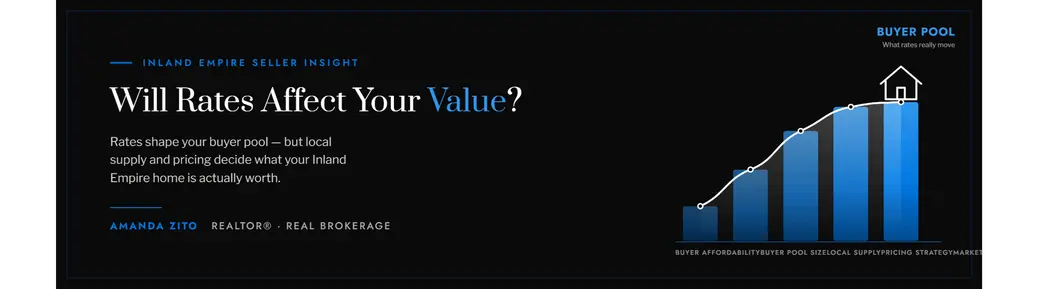
Will mortgage rates affect my home's value? Yes — but indirectly. Rates shape buyer affordability and demand in the Inland Empire, which in turn shapes home prices. Your home's value depends more on local demand, condition, and pricing strategy than on the rate headline itself.
Why Sellers Keep Asking About This
If you're thinking about listing in Riverside, Corona, Eastvale, Ontario, Rancho Cucamonga, Murrieta, or Temecula, you've probably seen a mortgage rate headline and wondered what it means for your home's price tag. It's a fair question. Rates and home values are connected, but not in the direct, one-to-one way most headlines suggest.
Here's the distinction that matters: mortgage rates don't set your home's value. Buyers do — and rates influence how many buyers can afford to compete for it.
How Mortgage Rates Actually Connect to Home Value
Your home's value is a reflection of what a qualified buyer is willing and able to pay for it, given everything else on the market at that moment. Mortgage rates enter the picture through the "able to pay" part of that equation.
When rates rise, a buyer's monthly payment goes up for the same loan amount. That can push some buyers to lower their target price range, or it can push them out of the market entirely while they wait. When rates fall, the opposite happens — buyers can often afford a higher purchase price at the same monthly payment, and more buyers re-enter the market.
That shift in buyer purchasing power is what eventually shows up in home values — not because rates directly reprice your home, but because they reshape the size and strength of your buyer pool.
The Buyer Pool Effect
A smaller buyer pool typically means:
- Fewer competing offers
- More negotiating room for buyers on price or terms
- Homes sitting on the market a bit longer before going under contract
A larger buyer pool typically means the reverse — more competition, less room to negotiate, and homes moving faster.
This is why two homes with identical square footage and finishes can sell for different prices in different rate environments, even if nothing about the house itself has changed.
Local Supply Still Drives the Rest of the Story
Rates are only half the equation. The other half is how many homes are actually for sale in your part of the Inland Empire at any given time. A rate shift that shrinks the buyer pool matters much more in a neighborhood with plenty of competing listings than in one where inventory is already tight. If there are fewer homes than buyers in your area, your home can hold its value even when rates move against buyers — because there simply isn't enough competing supply to give buyers leverage.
This is also why "the market" isn't one single thing. Riverside County and San Bernardino County each have pockets — by city, by school attendance area, by price point — where supply and demand look nothing alike, even a few miles apart.
What This Means for Your Listing Strategy
Instead of trying to time your sale around rate predictions, focus on the factors that are actually in your control:
Pricing strategy. In a market where buyers are more rate-sensitive, an accurate, competitive list price does more to attract offers than waiting for rates to move. Overpricing in a tighter-affordability environment tends to backfire — buyers with a monthly payment ceiling will simply scroll past.
Condition and presentation. When buyer budgets are tighter, move-in-ready homes have an edge over ones that need obvious work. Buyers stretching to afford a payment are less likely to also budget for repairs.
Timing around your own life, not the headlines. Rate forecasts change often and are notoriously hard to predict even for economists. A sale timed around your actual goals — relocation, downsizing, a life change — tends to work out better than one timed around guessing where rates go next.
Working with local data, not national averages. National rate coverage doesn't tell you what's happening on your specific street in Eastvale or Rancho Cucamonga. A current comparative market analysis for your home and neighborhood gives you a far more accurate read than any headline will.
Frequently Asked Questions
Do higher mortgage rates always lower home values? Not necessarily. Higher rates reduce buyer affordability, but if local inventory is also tight, homes can still hold or gain value because buyers have fewer alternatives to choose from.
Should I wait to sell until rates drop? Not automatically. Rate timing is difficult to predict, and waiting means missing the buyer pool that's active right now. Your specific goals and local inventory conditions usually matter more than trying to time a rate cycle.
How do I know what my home is worth in today's rate environment? The most reliable way is a current comparative market analysis based on recent, similar sales in your specific Inland Empire neighborhood — not a national rate trend or an automated online estimate.
What's Your Home Worth Right Now?
Rate headlines can only tell you so much. If you're considering selling in the Inland Empire and want a clear, current read on what your home is actually worth — factoring in your neighborhood, your buyer pool, and today's conditions — I'm happy to walk through it with you.
Amanda Zito Real Estate Agent, Real Brokerage Serving the Inland Empire — Riverside County & San Bernardino County
Reach out anytime to talk through your home's value and the right timeline for your goals.
Categories
Recent Posts











“Your goals come first. My job is to help you make the right move.”